
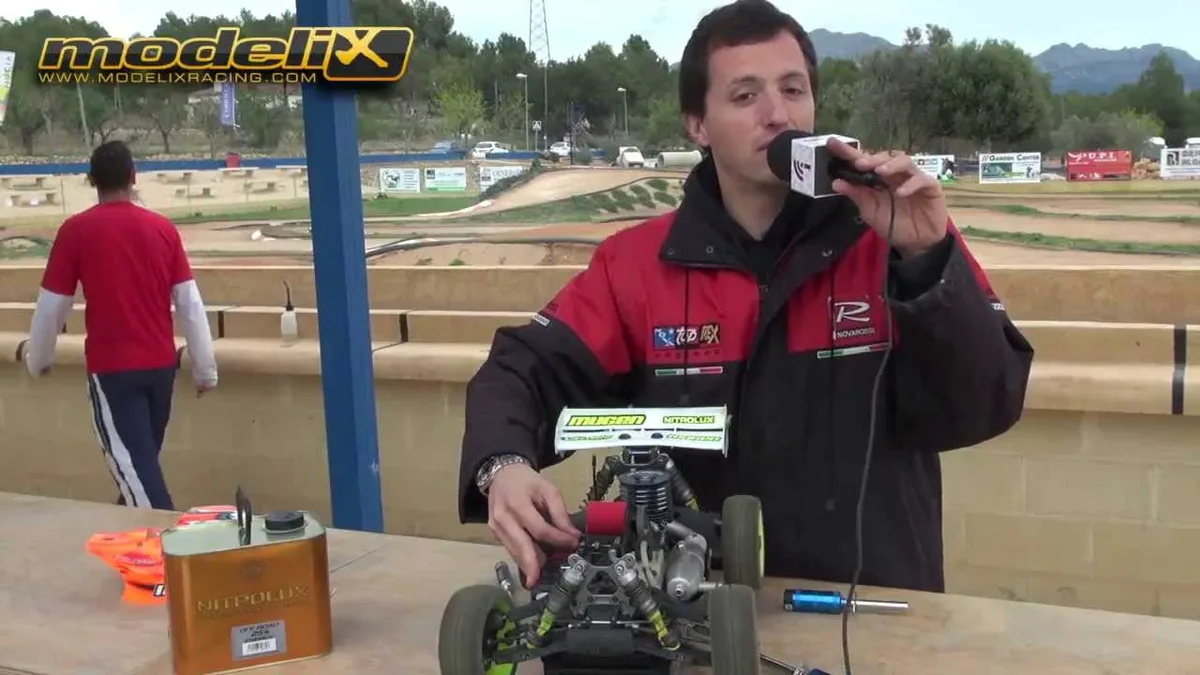
Many people have questions about breaking in their engine. Fair enough — a good break-in = engine life. There are many ways to do it, but few that are truly effective. Here we show how Christian Gordi (ModelixRacing manager) breaks in one of his engines (Ultimate Engine).
How to break in an RC nitro engine:
I can assure you that if you break in your engine exactly as Christian explains, it will last a long time!
Let's explain how we usually do break-ins. Contrary to what most people think, break-ins are fast — people take too long, leave them idling for ages with a very rich mixture.
You'll see that with this running-in method, after one tank we're already running almost like a broken-in engine — not in race trim, but with a tune you can drive properly around the track.
Crucially, warm the engine up properly before hitting the track — an engine must be broken in at the temperature it will work at.
First we'll do the initial start, then once it's tuned on the bench — no more than half a tank — we go straight to the track.
For the first start: a well-charged glow starter (if the glow starter isn't charged, we have a problem), a starter box with enough power to turn the engine, and a bit of enthusiasm so everything works.
We'll take the glow starter, prime the engine beforehand, and once primed we'll open the carb slightly, hold the glow starter for 5 seconds to heat the plug properly and... now it's running.
Leave it a moment and start trying to keep idle without stalling by leaning the low needle. If it still struggles to rev and blows lots of smoke and oil, keep leaning. The goal is to get the lows almost at their setting. If needed, lean the high needle too.
Once we've achieved this the engine is ready to hit the track and start running in. To make sure we haven't over-leaned the high, open the high needle 10 minutes to ensure it's not too lean.
Now go straight to the track without more tanks on the tuning bench. After running a bit, come in and start leaning the high needle to get the engine working at a temperature close to its normal range between 90 and 100 degrees as soon as possible.
Notice how the engine runs very well now — on the next lap we'll come in and lean the high needle at least a quarter turn. Some may think the engine has to run rich; this engine gets plenty of fuel, excessive even — there's no danger. The only danger would be a very new engine going to the track cold and opening full throttle on the first straight — the engine wouldn't have expanded and mini seizures could occur. If we do this with the engine well warmed up and expanded, as it should, mini seizures don't happen.
Engines after two or three tanks get oily because the sleeve and piston start to seat — then they go through what we'd call a break-in phase. We'll keep leaning and suddenly see lots of oil because a break-in phase has passed.
When running in an engine already at good temperature, it's very important not to stay at partial throttle — give it full throttle so fuel gets in and lubricates.
We'll lean the high needle as the engine asks for it and control temperature — when an engine is very new we'll lean it but always leaving about 10 minutes of rich margin.