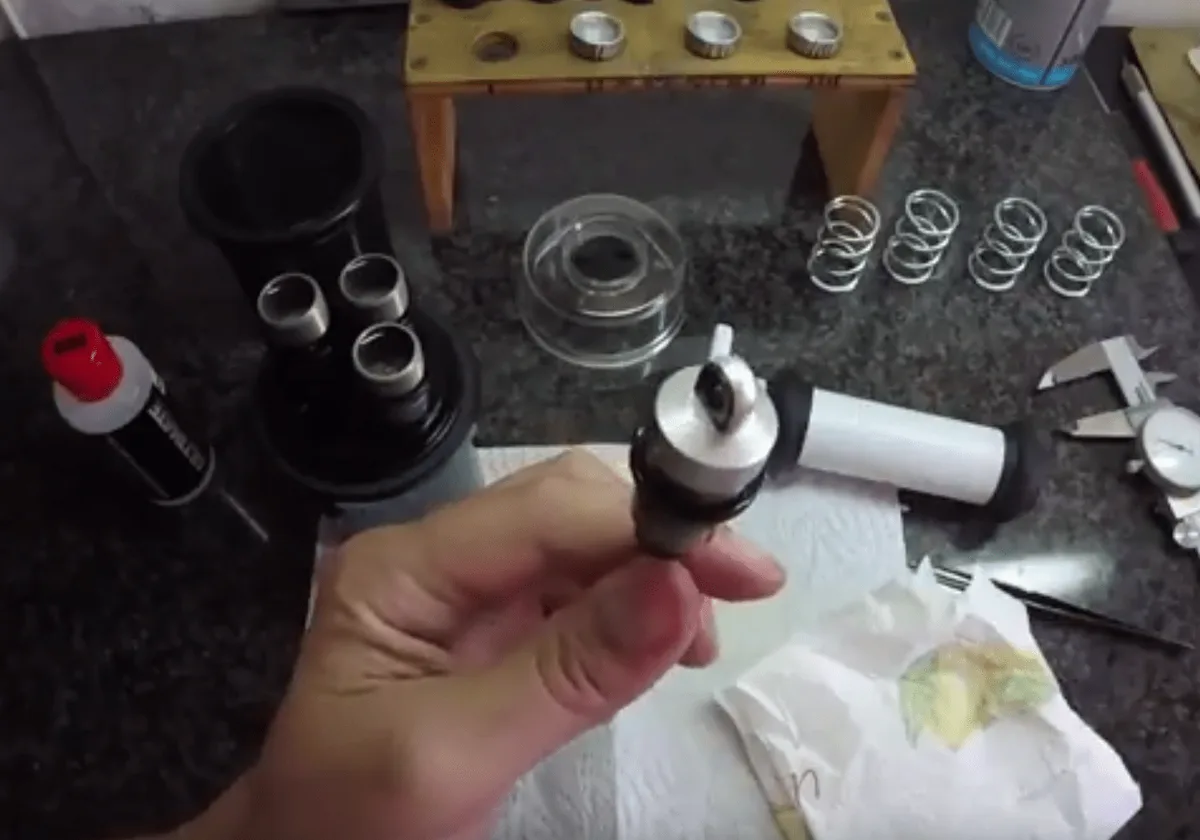
Today we bring you a new tutorial again thanks to Dioni Santana, where he explains how he fills his shocks and differentials.
He also shares tricks to get everything perfect and tips that help with setup, for example:
- Marking the shocks
- Marking preload threads
- Measuring shaft rebound...
Here's the video — feel free to share this article!
Hello friends, welcome to our Santana RC channel,
Today we're doing a tutorial that many of you asked for on how we fill shocks the way I do it.
On the Mugen MGT7, the latest tests we've done and what worked best for us is 800-weight silicone in all four shocks. We're also using white springs — we've tried grey and blue, and lately white is what works best for us. Everyone has their driving preference; Toni always likes a slightly nervous car with plenty of steering, and with 800 and white springs we get exactly what he likes.
I always like to mark the shocks, as you can see here — front with 1/2 and rear with 3/4 — so even if you clean and mix them up you always know which shock goes where for ride height and the rest. I also mark the preload threads on the shocks so we know how much preload we applied — a quarter turn, half turn, one turn — and we don't get confused.
The first step when filling shocks is to put them on the vacuum pump. After removing the air, the first thing I do is thread a little, then take the shaft — I do it at zero rebound. Insert the shaft fully and start threading; as you can see the air and excess silicone start coming out. Keep threading slowly until all the air is out — now all the silicone is out and it's at zero rebound.
To check that a shock is filled perfectly, hold it and push/pull the shaft quickly to see if there are bubbles — you notice right away if there's a strange noise or feel, or if it's smooth; that's how you know if it's properly filled or not.
In theory you shouldn't overfill, but if when inserting the shaft fully it won't go in and stays forced, you know there's too much silicone — especially when checking a shock and you're not sure if it's properly filled. If you fill it this way it should always be perfect. For rebound: if you want 50% rebound, measure the shaft with calipers, find half that length, use a spacer, close the shock cap, and when you remove the spacer it will rebound to halfway. For maximum rebound, leave the shaft fully extended, close the cap without touching the shaft, and when you open it the rebound goes to full extension. After testing we almost always run with rebound; on Super GT we've tried it now with rebound but haven't tested everything yet — on Mugen GT, GTL, Meseta and other cars we've almost always gone toward rebound because that's the feel Toni prefers when driving. That's our easy, comfortable way to fill shocks, and they damp well. Another question we get is how far to fill differentials — I'll show you: silicone is still coming out with the bubble alive; fill until it covers the top cross pin of the spider gear, not all the way to the top — just to that cross pin. When it heats up, materials and silicone expand, and if you overfill it can try to blow the diff; with this amount I never get it wrong. Close it up with screws and you're done. As I posted in the setup video, we run 1,000,000-weight in the front diff — this one is quite thick and hard to inject — and 40,000 in the rear diff. Hope you liked it; as always, any questions or suggestions, we're here on the channel and on Facebook. Cheers friends!